7 Best Online Custom T-Shirt Printing Services Compared for Print Quality and Shirt Materials
Choosing among the best online custom T-shirt printing services is not simply a matter of finding the lowest price. The shirt blank, print method, artwork preparation, production controls, and order size all affect how the finished garment looks, feels, and holds up after washing.
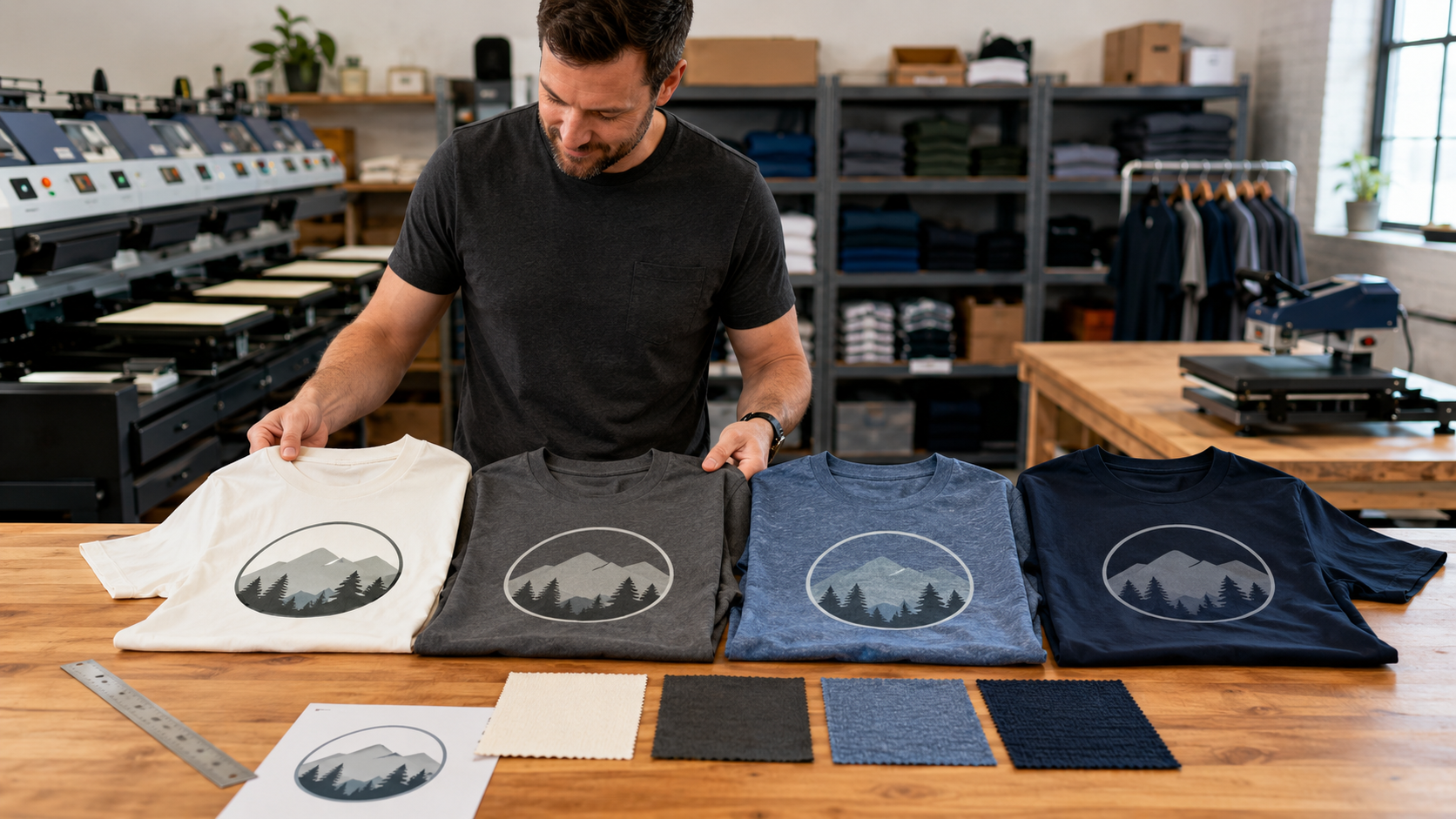
Quick answer: which service is best?
For businesses and group orders that want guided garment selection, proofing, and a consistent finished product, a full-service custom apparel shop is usually the safest choice. Apparel Junction is especially well suited to company apparel, events, staff programs, and coordinated reorders. Printful is a strong fit for print-on-demand ecommerce, Printify offers broad product choice through multiple print providers, Custom Ink is convenient for guided group ordering, RushOrderTees emphasizes speed, Real Thread specializes in a soft water-based print feel, and VistaPrint is easy for basic promotional orders.
No service is automatically best for every design. A premium ring-spun cotton shirt with the wrong print process can disappoint, while a well-matched budget shirt and print method can perform very well. Compare the complete production plan—not the website mockup alone.
How we compared online custom T-shirt printing services
This comparison focuses on the factors that buyers can evaluate before ordering:
- Print-process fit: Whether the provider offers the right process for bold spot colors, photo detail, stretch fabrics, polyester, or small personalized runs.
- Garment selection: Availability of budget cotton, ring-spun cotton, heavyweight, tri-blend, performance, women’s, youth, extended-size, and specialty styles.
- Production consistency: Whether one shop controls production or a network of independent providers may fulfill the order.
- Proofing and human support: The level of artwork review, placement guidance, color discussion, sizing help, and problem resolution.
- Best order type: Whether the service is built for one-off ecommerce fulfillment, a planned bulk order, a rush event, or an ongoing company apparel program.
Important comparison note
Catalogs, print methods, production locations, and garment availability change. Treat this as a decision framework, then confirm the exact blank, decoration process, production time, and proof for your order. Always test a sample before launching a large retail or employee program.
Best online custom T-shirt printing services: side-by-side comparison
| Service | Print-quality strengths | T-shirt material options | Best for | Watch before ordering |
|---|---|---|---|---|
| Apparel Junction | Human review and process selection across screen printing, DTF, sublimation, embroidery, and other decoration methods; useful when logo color, placement, durability, and repeat consistency matter. | Business, team, event, workwear, performance, retail-soft, heavyweight, women’s, youth, extended-size, and coordinated apparel options. | Businesses, staff uniforms, trade shows, team orders, bulk programs, and company stores. | Request the exact style number and confirm substitutions, sizes, deadline, and decoration method in writing. |
| Printful | Built for print-on-demand with DTG, direct-to-film options, and all-over printing on eligible products; convenient for detailed full-color art and individual fulfillment. | Strong selection of common POD blanks, including cotton, blends, garment-dyed styles, and performance or all-over-print products. | Ecommerce brands that need one-at-a-time fulfillment and integrations. | Order samples because print feel and color can change by garment color, fiber content, pretreatment, and process. |
| Printify | Large provider marketplace gives access to multiple methods and production partners. | Very broad catalog spanning budget, premium, heavyweight, garment-dyed, eco-minded, and specialty shirts. | Sellers who want catalog breadth, provider choice, and POD flexibility. | Print quality, packaging, production time, and color may vary by selected print provider. Sample the exact provider and product combination. |
| Custom Ink | Guided ordering, artwork assistance, and established screen-printing and digital-printing workflows. | Broad range of familiar promotional, premium, performance, and specialty brands. | Group orders, events, schools, teams, and buyers who want an easy guided workflow. | Compare the exact product, print process, minimums, and all-in price rather than assuming every catalog item prints the same way. |
| RushOrderTees | Multiple printing methods with an ordering model designed around fast production and deadline-driven jobs. | Budget cotton, soft retail tees, heavyweight styles, blends, and performance apparel. | Events and organizations with a firm, near-term deadline. | A rush timeline leaves less room for sampling. Confirm proof approval cutoffs, shipping method, and the consequence of late artwork changes. |
| Real Thread | Known for water-based and discharge-style screen printing that can produce a soft, breathable feel on compatible garments. | Premium-focused cotton, ring-spun, blend, and responsible-brand options. | Retail-style merchandise where a soft print hand is a leading priority. | Water-based results vary by fabric, garment color, dye chemistry, and design. Ask how the chosen shirt will affect color and opacity. |
| VistaPrint | Simple online workflow for straightforward logo and promotional apparel orders. | Common cotton, blend, performance, and business-casual basics. | Small businesses ordering basic promotional shirts alongside other marketing products. | The streamlined workflow may offer less production consultation than a specialist apparel shop. Verify garment weight, fit, and print method. |
Detailed review of each custom T-shirt printing option
1. Apparel Junction: best for guided business and group apparel
Apparel Junction is a strong choice when the job involves more than uploading art and choosing a quantity. A production specialist can help pair the logo, garment, order size, deadline, and expected use with an appropriate decoration process.
This matters for businesses ordering employee shirts, sales-team apparel, trade-show uniforms, recurring department orders, or a coordinated program that may also include polos, hats, jackets, bags, patches, and promotional products.
Material advantage: Buyers are not limited to a narrow POD catalog. They can compare budget promotional cotton, soft ring-spun shirts, heavier work-ready tees, moisture-wicking performance options, blends, and coordinated styles.
Explore custom T-shirts or review Apparel Junction’s decoration services.
2. Printful: best for controlled print-on-demand fulfillment
Printful is designed for ecommerce sellers who want products printed after each sale. Its model is convenient for testing designs without holding finished inventory, and it supports detailed full-color artwork through digital processes.
Material advantage: The catalog includes widely used retail-soft cotton shirts, blends, garment-dyed options, and products intended for all-over printing.
Best buying move: Order the same artwork on two or three candidate shirts. Compare print sharpness, opacity, hand feel, shrinkage, seam behavior, and color after washing.
3. Printify: best for broad POD catalog choice
Printify connects sellers with a network of print providers. That model creates a large product selection and lets sellers compare provider locations and costs.
Material advantage: Buyers can find budget tees, premium ring-spun cotton, garment-dyed shirts, heavyweight silhouettes, performance fabrics, and specialty cuts.
Main tradeoff: The platform itself is not the only production variable. The selected provider, printer, pretreatment, curing, quality control, and packaging can influence the final result. A successful sample from one provider should not be treated as proof of another provider’s output.
4. Custom Ink: best for an easy group-order workflow
Custom Ink is familiar to teams, schools, events, and organizations that want design assistance and a guided ordering process. It offers screen printing and digital printing, allowing the production method to be matched to quantity and artwork.
Material advantage: Its catalog covers common promotional tees, premium soft shirts, athletic options, specialty fits, and recognizable garment brands.
Best buying move: Ask which printing method will be used on the exact shirt and whether the quoted price, color result, and print feel change at a different quantity.
5. RushOrderTees: best when speed is central
RushOrderTees is positioned for deadline-driven custom apparel and offers several decoration methods. It can be a practical option when an event date is close and a conventional production schedule is no longer possible.
Material advantage: The catalog includes basic cotton, soft fashion tees, blends, heavyweight garments, and performance products.
Best buying move: Separate “production time” from “arrival date.” Confirm proof approval, inventory reservation, shipping level, weekend handling, and what happens if a shirt size becomes unavailable.
6. Real Thread: best for a soft water-based print feel
Real Thread’s specialty is a softer retail-style print, particularly through water-based techniques on compatible shirts. This can be attractive for branded merchandise where customers may reject a thick print feel.
Material advantage: The selection emphasizes premium and soft garments that complement a retail-ready result.
Best buying move: Request a physical sample on a similar garment color. Water-based and discharge results can look different from a bright plastisol or transfer print, especially on dark or blended fabrics.
7. VistaPrint: best for simple promotional ordering
VistaPrint can be convenient for a buyer who wants basic logo shirts in the same ecosystem as business cards, signs, or other marketing materials.
Material advantage: Buyers can choose from common promotional and business-friendly basics without navigating an enormous apparel-only catalog.
Best buying move: Read the garment specifications rather than relying on the product photo. Fabric weight, fiber content, side seams, fit, and sizing range tell you more about the shirt than the mockup does.
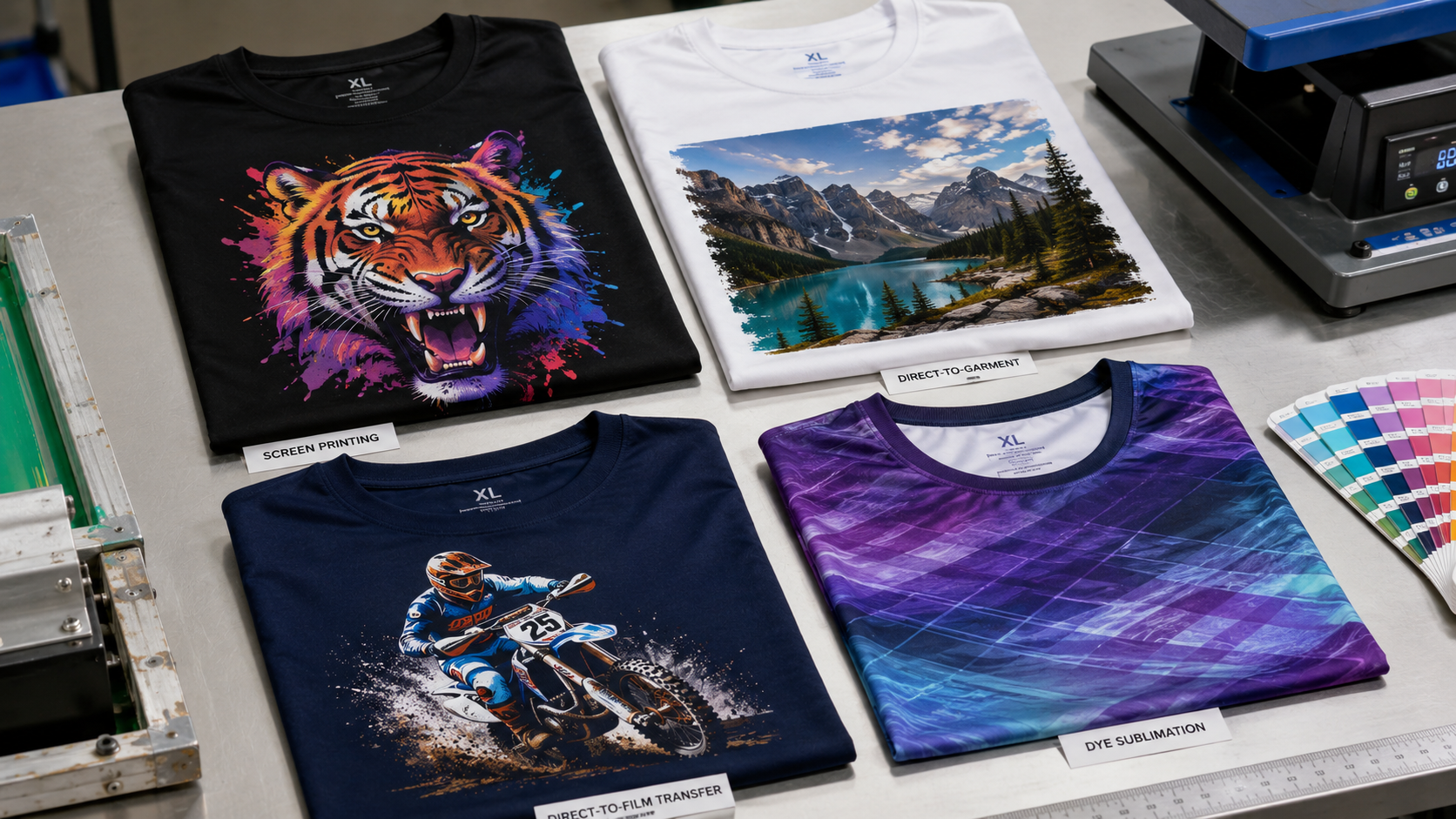
How print method changes quality more than the company name
A service can produce excellent work with one process and a less suitable result with another. Before choosing a provider, identify what your design actually requires.
| Print method | Usually best for | Typical feel and appearance | Material considerations | Questions to ask |
|---|---|---|---|---|
| Screen printing | Planned quantities, bold logos, repeat orders, team and business shirts | Vibrant and durable; print can range from soft to substantial depending on ink, underbase, mesh, and coverage | Works well on many cotton and blend garments; polyester may need migration-resistant ink | What ink system, underbase, color-matching method, and cure controls will be used? |
| DTG | Small runs, one-offs, gradients, photographs, highly detailed multicolor art | Detailed and generally soft, especially on cotton; opacity and hand can vary on dark shirts | Usually strongest on cotton-rich, smooth-knit garments | How is the shirt pretreated, and has this exact garment/color been tested? |
| DTF | Full-color logos, small-to-medium runs, varied fabric types, personalized orders | Bright, sharp, and more noticeable to the touch than ink absorbed into fabric | Versatile across cotton, polyester, and blends when correctly applied | How is the transfer cured, pressed, and tested for stretch and wash durability? |
| Water-based printing | Soft retail-style prints and breathable designs | Soft hand; color and opacity can be influenced by garment dye and fiber content | Best results depend heavily on fabric and shirt dye behavior | Will the selected garment discharge consistently, and can I approve a sample? |
| Dye sublimation | Polyester performance shirts and edge-to-edge artwork | Ink becomes part of the fabric, with no raised print layer | Requires compatible polyester and generally works best on white or light garments | Is the product true sublimation-ready polyester, and will seams or folds create white areas? |
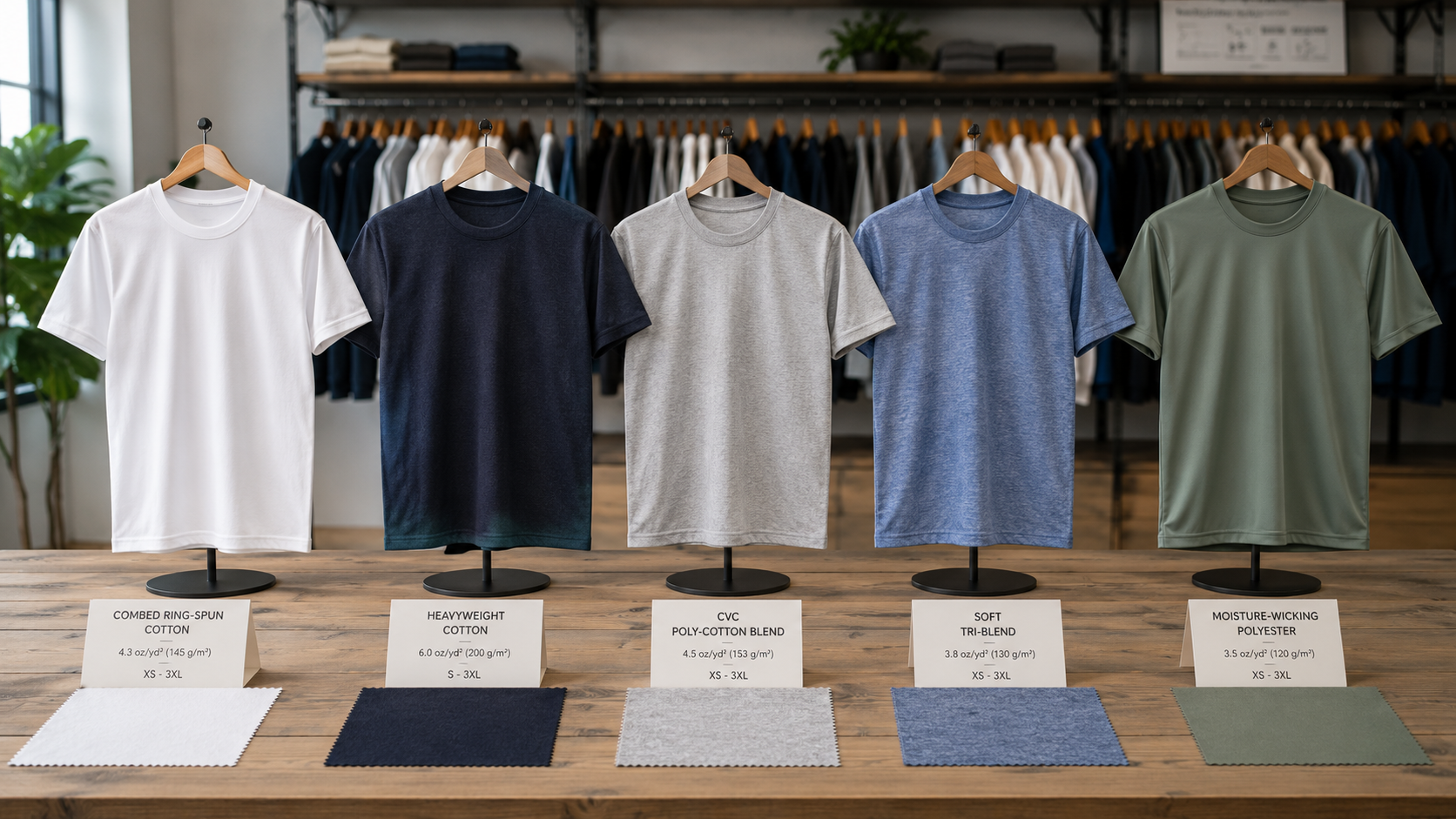
Best T-shirt materials for print quality and comfort
Ring-spun cotton: the safest premium all-around choice
Combed ring-spun cotton usually has a smoother surface and softer hand than coarse open-end cotton. That smoother knit can help detailed digital prints appear cleaner and makes the finished shirt feel more retail-oriented. It is a smart default for customer-facing staff, merchandise, and events where comfort influences whether people wear the shirt again.
Heavyweight cotton: structure, durability, and a modern silhouette
Heavyweight tees feel more substantial and can support bold streetwear, workwear, and premium merchandise positioning. Weight alone does not guarantee quality, so also check yarn type, shrinkage expectations, collar construction, fit, and whether the fabric surface suits the intended print process.
CVC and poly-cotton blends: softness with easier everyday wear
CVC fabrics contain more cotton than polyester and often balance softness, shape retention, and reduced shrinkage. Blends can produce a slightly different or more vintage-looking result with some ink systems. Ask for a printed sample when brand-color accuracy is important.
Tri-blends: very soft, lightweight, and intentionally heathered
Tri-blends commonly combine cotton, polyester, and rayon. They can feel exceptionally soft, but the heathered fabric and mixed fibers may mute or texture the print. That can be desirable for lifestyle merchandise and less desirable for a crisp corporate logo.
Performance polyester: best for heat, movement, and moisture management
Polyester is useful for outdoor crews, athletic events, warm environments, and jobs requiring moisture management. It also requires the right production process. Heat, dye migration, scorching, press marks, and fabric stretch should be considered before approving the method.
Expert shortcut: select the wearer before selecting the shirt
A warehouse crew, sales team, charity-run participant, and retail customer do not need the same garment. Define the wearer’s environment, desired fit, laundering habits, and expected use first. Then compare shirt blanks and decoration methods.
A smart decision guide for business and event buyers
- Start with the use case. Decide whether the shirts are uniforms, giveaways, merchandise, one-time event apparel, or an ongoing employee program.
- Set a delivered budget range. Include garment, decoration, setup, personalization, tax, shipping, rush charges, and possible art fees.
- Choose the quality tier. Compare at least one budget shirt, one soft mid-tier shirt, and one premium or specialty option.
- Confirm the print process. Do not accept “full color” as the complete answer. Ask whether the job is screen printed, DTG, DTF, sublimated, or produced another way.
- Review a real proof. Confirm logo size, placement, print colors, shirt color, imprint locations, names, and spelling.
- Test before scaling. For retail, recurring, or high-visibility programs, approve a physical sample or production-quality preproduction test.
- Plan the reorder. Save the garment style, color, print specification, artwork version, and placement measurements.
Common mistakes when comparing online T-shirt printers
Comparing prices without matching the exact shirt
A low quote on a basic open-end cotton shirt is not equivalent to a quote on a combed ring-spun, garment-dyed, heavyweight, or performance tee. Match the manufacturer, style number, color, sizes, print locations, and quantity before comparing price.
Judging print quality from a digital mockup
A mockup shows approximate placement, not actual ink opacity, hand feel, garment texture, color shift, or wash performance. A sample is the only reliable way to judge the complete product.
Ignoring extended sizes and fit consistency
Some styles stop at limited sizes, change construction in extended sizes, or have companion women’s and youth styles that do not match perfectly. Review a size chart and garment measurements before collecting employee sizes.
Using the same artwork for every process
Fine lines, distressing, gradients, tiny type, transparency, and low-resolution images behave differently in screen printing, DTG, and DTF. Let the printer review production art instead of sending only a screenshot or small web image.
Waiting until the deadline to approve
Production usually begins after final proof approval, product availability, payment, and art readiness are confirmed. Build time into the schedule for substitutions, size changes, freight, and a sample when quality is critical.
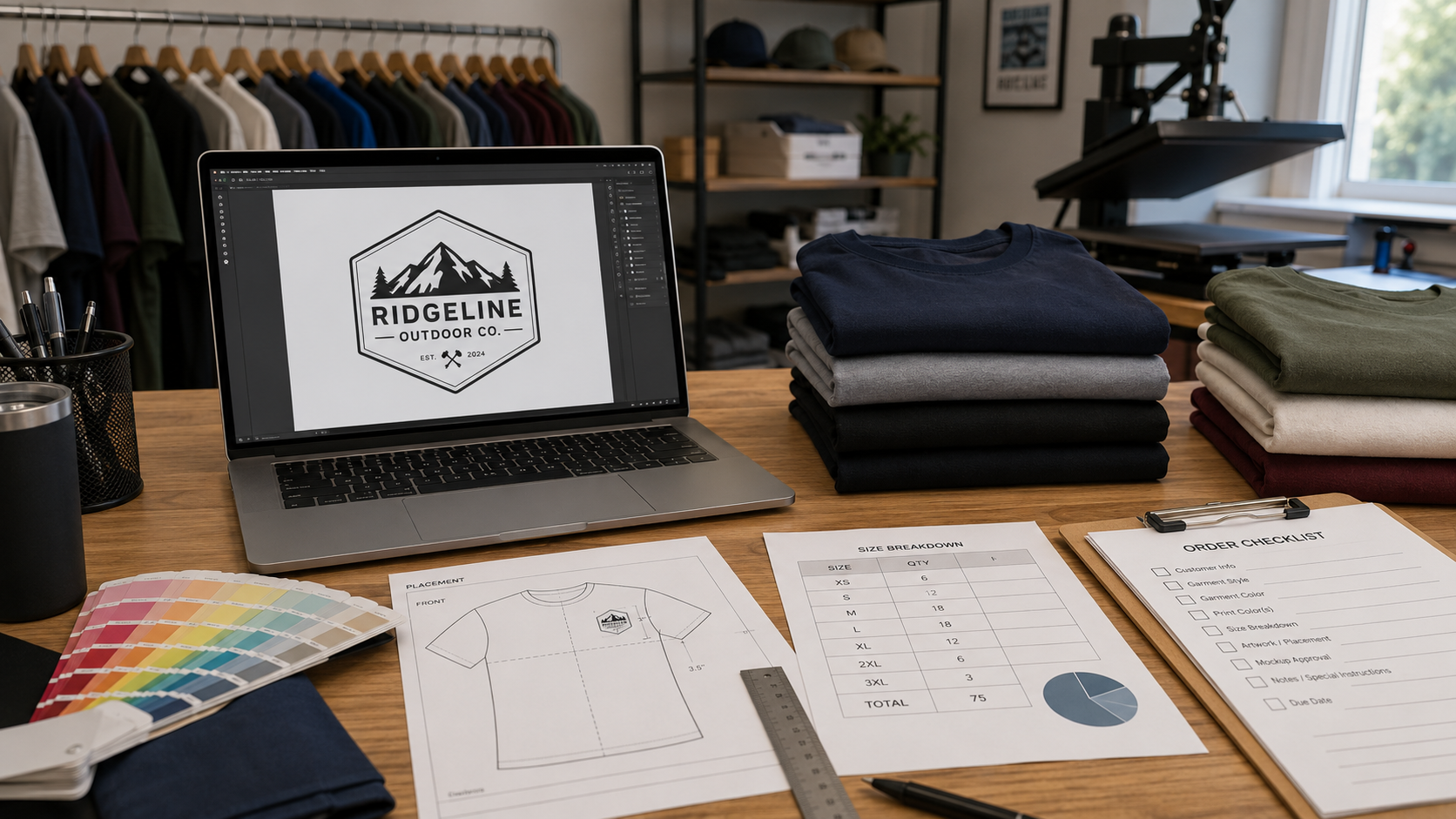
What to send for an accurate custom T-shirt quote
Custom T-shirt quote checklist
- Order quantity and size breakdown
- Preferred shirt style—or the wearer, use, fit, fabric, and budget requirements
- Garment colors and whether alternatives are acceptable
- Vector artwork when available, plus brand-color references
- Number of print locations and approximate desired print size
- Need-by date and delivery ZIP code
- Whether individual names, numbers, bagging, sorting, or fulfillment are needed
- Whether this is a one-time order or a program requiring future reorders
- Any required sample, proof, compliance, or purchase-order process
When a company store is better than repeated group orders
Organizations with multiple departments, locations, or frequent new hires can outgrow spreadsheet-based apparel ordering. A managed company apparel store can give approved users access to selected products, logos, and decoration locations while reducing repeated art setup and order confusion.
A company store is especially useful when employees purchase individually, managers issue apparel allowances, products need approval, or the organization wants a controlled branded-apparel catalog that includes more than T-shirts.
Helpful resources before you order

Compare the shirt and print process before you commit
The best online custom T-shirt printing services should help you select a garment and decoration method that fit the wearer, artwork, budget, deadline, and reorder plan. Apparel Junction can review your logo and recommend practical shirt options for business apparel, employee programs, events, teams, and branded merchandise.
Request a custom T-shirt quote Visit Apparel JunctionFrequently asked questions
What is the best online custom T-shirt printing service for print quality?
The best online custom T-shirt printing service depends on the artwork, shirt, order size, and expected use. A full-service shop such as Apparel Junction is a strong choice for business and group orders that need garment guidance, proofing, and process selection. POD platforms can be better for one-at-a-time ecommerce fulfillment. Ask for the exact garment and print method, then approve a sample for quality-critical orders.
Which T-shirt material produces the best print quality?
Smooth, cotton-rich ring-spun shirts are a reliable choice for detailed printing and a soft retail feel. Heavyweight cotton supports structured garments and bold designs, while polyester is appropriate for performance wear and sublimation. The best material is the one matched to the print method and wearer.
Is screen printing better than DTG or DTF?
Screen printing is often ideal for planned quantities, bold spot colors, repeat orders, and durable business or team apparel. DTG is useful for detailed, full-color art and very small runs on cotton-rich shirts. DTF is versatile across many fabrics and order sizes. None is universally better; the correct choice depends on design, fabric, quantity, feel, and budget.
How can I compare shirt quality between two online printers?
Compare the same manufacturer and style number, not just labels such as “premium” or “soft.” Review fiber content, fabric weight, yarn type, fit, seams, collar, color availability, size range, print method, proofing, and delivered price. Then order samples printed with similar artwork.
Should I order a sample before placing a bulk custom T-shirt order?
Yes, especially for retail merchandise, employee uniforms, recurring programs, dark garments, blended fabrics, or color-sensitive logos. A sample reveals print feel, actual color, fit, shrinkage, placement, opacity, and wash behavior that a digital mockup cannot show.
What should a business send to get a fast and accurate quote?
Send quantities and sizes, shirt preferences, garment colors, artwork, print locations, desired print size, delivery ZIP code, and need-by date. Also note personalization, sorting, bagging, fulfillment, or future reorder requirements. Complete information helps an online custom T-shirt printing service recommend the right method and avoid preventable delays.
Can an online custom T-shirt printing service handle employee reorders?
Yes, but the workflow differs. Some providers require a new group order, while others offer print-on-demand or a managed company store. For recurring staff apparel, ask whether the provider can preserve approved artwork, garment specifications, print placement, employee allowances, and product availability.
Final recommendation
Choose the provider whose production model fits your order. Use POD for individual ecommerce fulfillment, a rush specialist for an immovable short deadline, and a full-service apparel partner when shirt selection, print method, proofing, coordinated products, and future reorders matter. For business and group apparel, the lowest-risk path is to compare physical garments, approve the production method, and document the exact specification before the full run.