9 Best Websites for Custom T-Shirt Printing With No Minimum Order
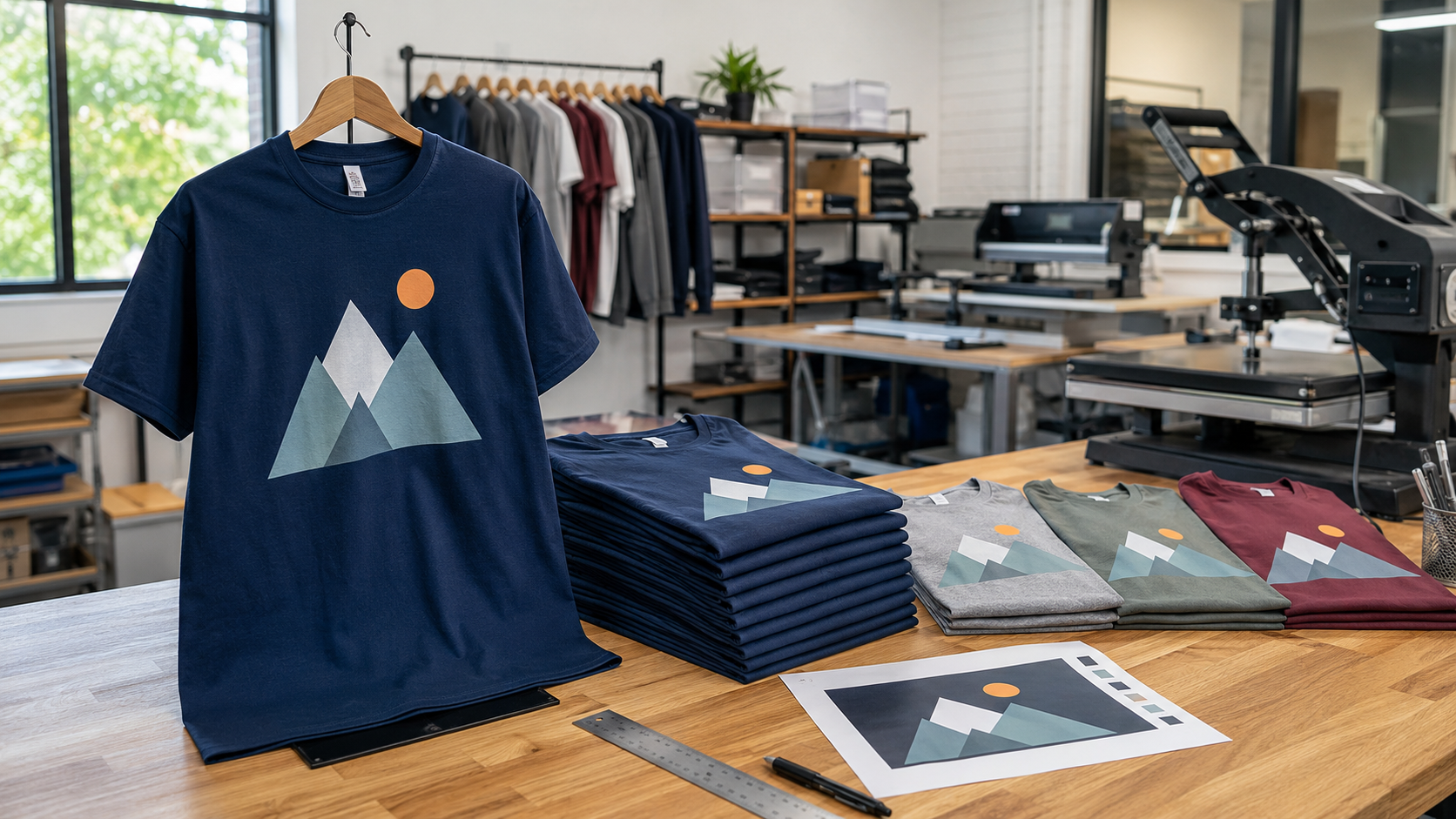
Ordering one sample shirt, a few employee tees, or a small set of event shirts should not require buying a full case. The best websites for custom T-shirt printing with no minimum make small orders practical, but they do not all serve the same buyer. Some are strongest for one-off gifts, some for print-on-demand stores, and others for business orders that may grow into larger screen-printed runs.
Quick answer: which no-minimum T-shirt website is best?
For most small business and team orders, start by choosing the ordering model—not just the website. Custom Ink and RushOrderTees are useful for guided online ordering; UberPrints and Spreadshirt work well for simple one-piece digital orders; Printful and Printify are better suited to print-on-demand fulfillment; Bonfire is designed around group campaigns and fundraising. A local or consultative shop such as Apparel Junction may be the smarter choice when logo placement, garment selection, employee sizing, color matching, or a later bulk order matters. Minimums can vary by garment and decoration method, so confirm the exact product before paying.
This guide compares nine commonly considered options and then shows how to choose based on print method, garment quality, turnaround, artwork help, and the likelihood that your “small order” will become a larger company apparel program.
Best websites for custom T-shirt printing with no minimum
| Website | Best for | No-minimum model | Potential drawback |
|---|---|---|---|
| Custom Ink | Teams, events, gifts, and buyers who want design assistance | Selected no-minimum products, including single-shirt options | No-minimum availability depends on the product and print method |
| RushOrderTees | Fast online ordering and time-sensitive small runs | Many products allow quantities from one shirt upward | Rush speed, premium garments, and extra print locations can raise cost |
| UberPrints | One-off digital prints and simple online design | Digital printing is available without a minimum on eligible products | Some colors or screen-printing choices may have quantity requirements |
| Bonfire | Fundraisers, campaigns, communities, and group ordering | No minimum for custom orders, with bulk discounts available | The campaign-oriented workflow may be more than a simple business reorder needs |
| Printful | Online stores and print-on-demand fulfillment | Products can be produced one at a time as orders are placed | It is a fulfillment platform, not always the best fit for hands-on local service |
| Printify | Sellers comparing print providers and product costs | One-at-a-time print-on-demand production | Quality, location, and consistency can vary by selected provider |
| Spreadshirt | Personal shirts, gifts, and simple individual orders | Single-item customization on many products | Less suited to detailed uniform programs or tightly controlled brand standards |
| VistaPrint | Buyers combining apparel with business marketing materials | No-minimum apparel is available on selected products | Decoration choices and garment selection may be narrower than a specialist apparel shop |
| Apparel Junction | Businesses that want product guidance, artwork review, local service, and room to scale | Order requirements depend on the garment and decoration process; request a product-specific quote | Not positioned as an anonymous one-click marketplace; the value is expert order planning |
How we evaluated no-minimum custom T-shirt websites
A useful ranking should look beyond whether a website accepts a quantity of one. We evaluated the options by the factors that affect the shirt you actually receive:
- True small-order availability: Can you order one or a few pieces without being forced into a larger quantity?
- Garment choice: Are budget, premium, heavyweight, performance, women’s, youth, and extended-size options available?
- Decoration method: Does the provider explain whether your order will use DTG, DTF, screen printing, sublimation, or embroidery?
- Artwork review: Will a person check resolution, line thickness, transparent backgrounds, placement, and print size?
- Business-order support: Can the provider manage size lists, employee reorders, multiple locations, or an online company store?
- Turnaround clarity: Are production time and shipping time shown separately?
- Reorder consistency: Can you reproduce the same garment, print size, placement, and colors later?
Detailed comparison of the top choices
1. Custom Ink: helpful for groups and guided design
Custom Ink is a familiar option for event shirts, family groups, clubs, and small company orders. Its online design tools are easy to use, and the company advertises selected products that can be ordered as a single shirt. Human artwork review is useful when the customer is not experienced with print files.
The key phrase is selected products. Product, color, and decoration choices can change the quantity requirement. Check the product page before assuming every shirt in the catalog qualifies.
2. RushOrderTees: strong for speed and straightforward ordering
RushOrderTees is designed for buyers who want to move quickly. Its no-minimum category includes many familiar shirt styles, and it emphasizes quick production and online design. It is a practical place to compare a one-piece test order with a larger quantity.
For a deadline, verify the date the order will arrive—not merely the production time. Shipping destination, artwork approval, garment availability, and rush fees can affect the final schedule.
3. UberPrints: practical for one digitally printed shirt
UberPrints clearly separates no-minimum digital printing from screen printing that may require more pieces. That makes it useful for a one-off design, sample, gift, or prototype. The workflow is built around designing online and choosing an eligible shirt.
Pay attention to garment color restrictions. Some colors may be available at any quantity while others have higher minimums because of the production process.
4. Bonfire: best suited to campaigns and group participation
Bonfire is especially useful when a group, cause, or community needs shirts without one person collecting every size and payment manually. It supports no-minimum ordering and also offers price breaks as quantity increases.
For a conventional uniform program with repeat employee orders, compare Bonfire’s campaign workflow with a dedicated company apparel store.
5. Printful: built for print-on-demand fulfillment
Printful is a logical choice for a brand or creator who wants shirts produced after an online customer places an order. There is no need to hold inventory, and the platform connects with ecommerce systems.
That convenience is different from ordering shirts for your own staff. Businesses that need coordinated sizing, local pickup, garment samples, or hands-on brand review may prefer a custom apparel shop.
6. Printify: useful for comparing print-on-demand suppliers
Printify gives sellers access to multiple production providers. That can create competitive pricing and a broad catalog. It also means the buyer must choose the provider carefully because location, equipment, garment availability, and consistency can differ.
Order a sample from the exact provider you plan to use. A sample from one network partner does not prove another partner will produce the same result.
7. Spreadshirt: simple for personal and one-off designs
Spreadshirt is convenient for a single personal shirt, gift, or uncomplicated design. It is less focused on consultative business apparel programs, but the simple customization process is appealing when you do not need detailed production planning.
8. VistaPrint: convenient when apparel is part of a larger marketing order
VistaPrint can be convenient for a small business already ordering cards, signs, or promotional materials. Selected apparel products have no minimum. Compare the garment and decoration specifications carefully rather than choosing solely because everything can be purchased in one checkout.
9. Apparel Junction: best when the order needs an expert, not just an upload button
For business owners and office managers, the “best website” may be the one backed by a real production team. Apparel Junction helps customers compare DTF printing, screen printing, embroidery, and other decoration methods based on quantity, artwork, garment fabric, deadline, and intended use.
This is especially valuable when a test shirt may turn into uniforms, trade-show apparel, sales-team shirts, onboarding kits, or recurring employee orders. Contact the team for the minimum that applies to the exact garment and process you need.
Need a small custom shirt order that can grow with your business?
Apparel Junction can review your logo, recommend the right garment and print method, and quote the exact quantity you need. For custom T-shirt printing with no minimum or the lowest practical minimum for a specific product, send the details below and ask which production option fits best.
Request a custom apparel quoteWhich printing method is best for a one-shirt or small order?
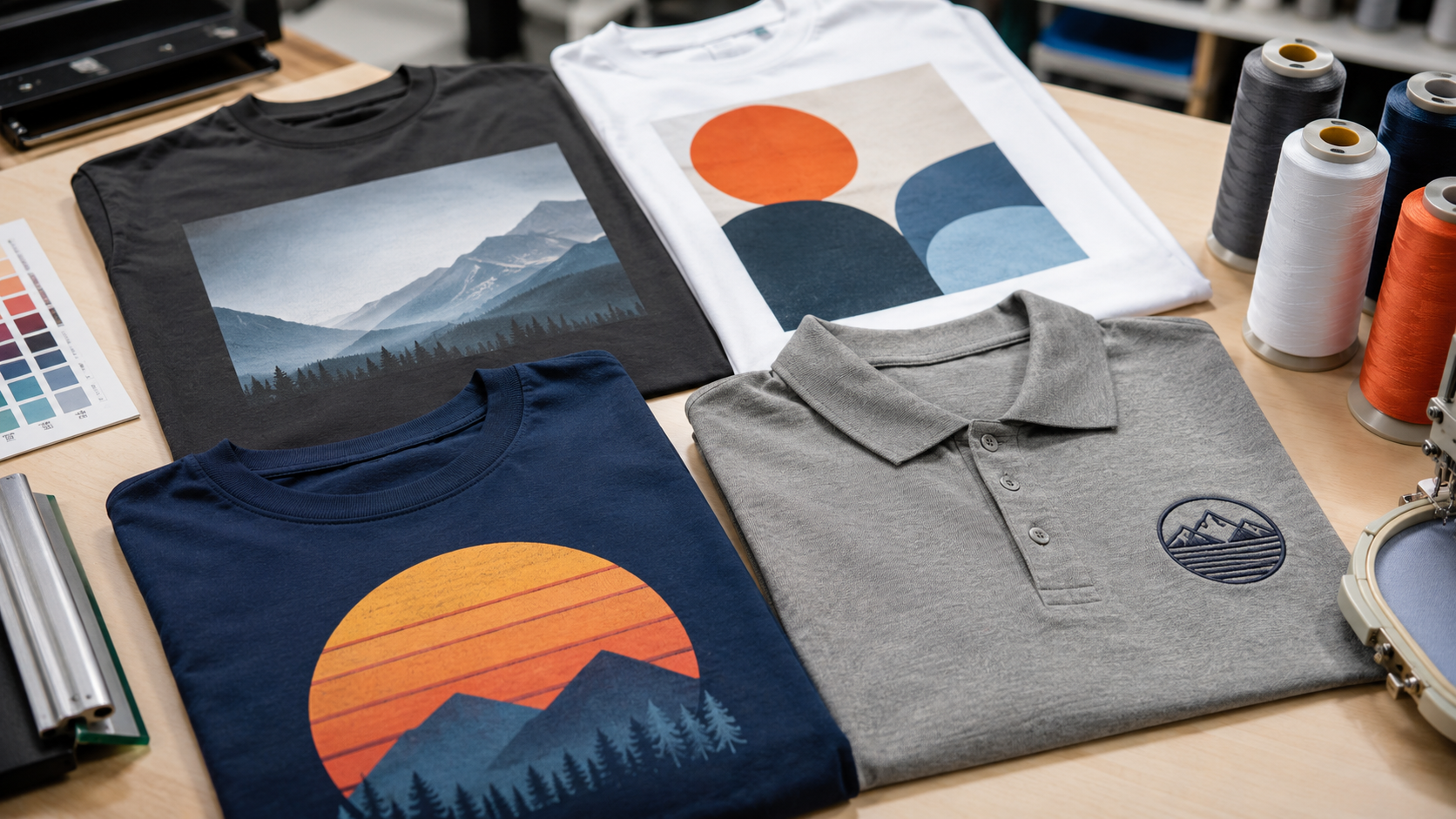
| Method | Best use | Small-order fit | What to know |
|---|---|---|---|
| DTG | Detailed, full-color artwork on compatible cotton garments | Excellent for one or a few shirts | Results depend on garment composition, pretreatment, and printer calibration |
| DTF | Full-color logos on cotton, polyester, blends, and many garment types | Excellent for small mixed orders | Feel and durability depend on film, powder, ink, curing, and pressing quality |
| Screen printing | Larger runs, simple color counts, strong repeatability | Usually less economical for one piece | Setup cost is spread across the quantity, so unit price improves as volume rises |
| Sublimation | Full-color decoration on suitable light polyester products | Can work well for small orders | Not the standard choice for dark cotton T-shirts |
| Embroidery | Polos, hats, jackets, uniforms, and premium business apparel | Possible for small orders, but digitizing may affect first-order cost | Tiny text, gradients, and very detailed art may need simplification |
How to choose the right website for your order
Choose by your real goal
A single birthday shirt, one employee sample, a 12-person trade-show team, and an ecommerce brand all have different needs. Define the use before comparing websites.
Compare the delivered price
Look at the shirt, printing, extra locations, artwork charges, rush service, taxes, and shipping. A low advertised shirt price may be based on a larger quantity or a basic blank.
Check the exact garment
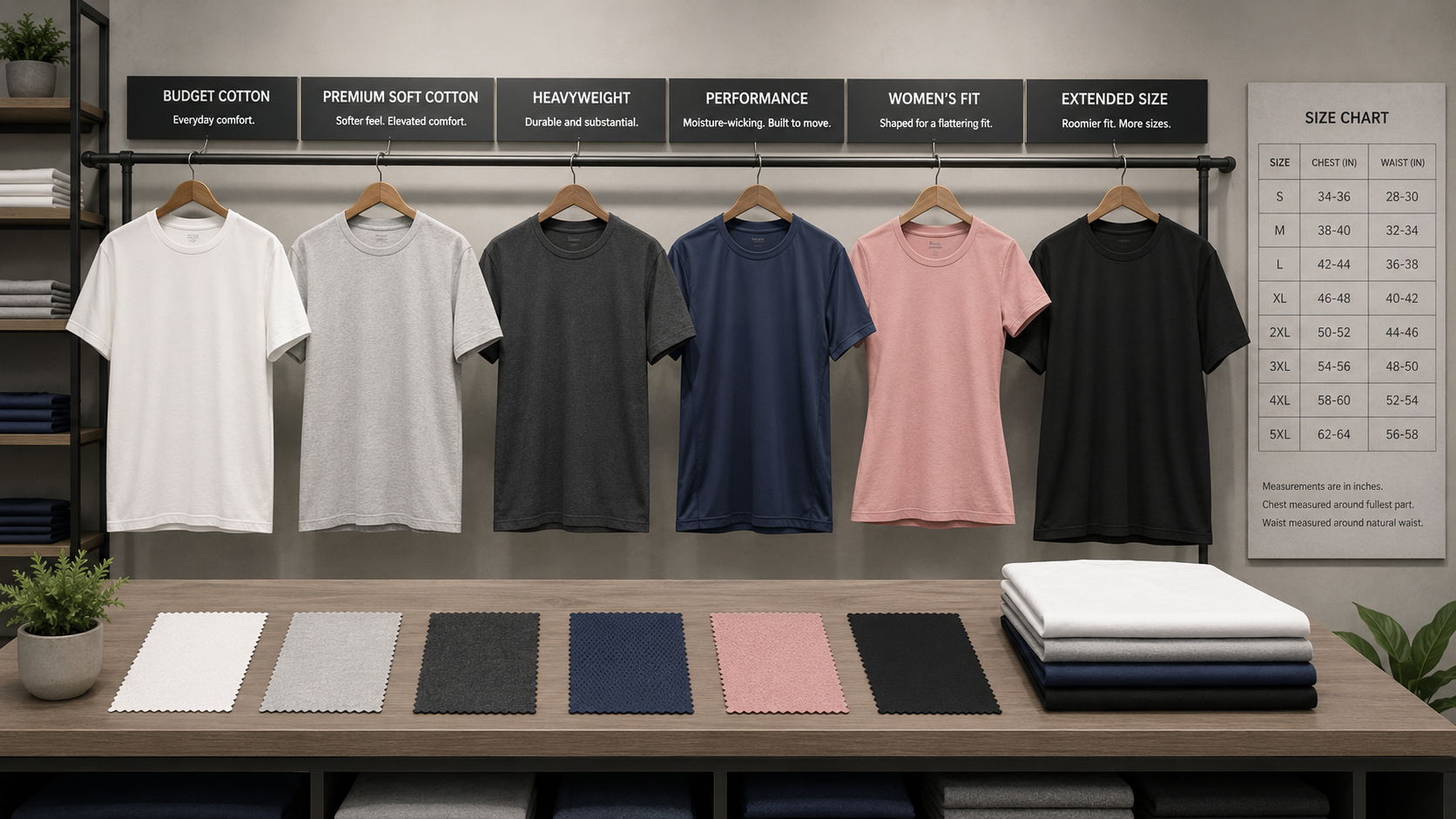
Ask for the brand, style number, fabric content, fit, available sizes, and color. A “premium soft shirt” is not a usable reorder specification. For general product research, brand websites such as SanMar and S&S Activewear provide garment specifications and size information.
Confirm artwork and placement
Ask how large the print will be, where it will sit, and whether a proof is included. A design that looks centered on a flat screen can appear too low or too wide when worn.
Plan for the second order
If the first shirt is a sample for employees, ask whether the same garment and production settings can be saved. Businesses may also benefit from an online company store that lets employees order approved apparel without rebuilding the order each time.
Common mistakes to avoid
- Assuming no minimum means no setup cost. A quantity of one can still include artwork, digitizing, or small-order charges.
- Choosing by price before choosing the garment. The blank shirt affects comfort, fit, shrinkage, opacity, and how the print looks.
- Uploading a small web logo. A 300-pixel image copied from a website may not print cleanly at full chest size.
- Ignoring print location. Front, back, sleeve, neck, and individual-name decoration each affect price and production.
- Approving a proof without checking dimensions. Review the stated print width and placement, not just the visual mockup.
- Waiting until the event week. Leave time for artwork approval, garment substitutions, production, shipping, and corrections.
- Expecting one decoration method to fit every quantity. The most economical method for one shirt may not be best for 100.
What to send for an accurate custom T-shirt quote
- Desired quantity, including whether you need one sample first
- Shirt type, color, brand, or budget range
- Adult, women’s, youth, and extended-size quantities
- Artwork file, preferably vector PDF, AI, or EPS when available
- Number of artwork colors or whether the design is full color
- Print locations and approximate dimensions
- Needed-in-hands date and delivery ZIP code
- Whether individual names, numbers, departments, or locations change by shirt
- Whether this is a one-time order or the start of an employee apparel program
These details allow a printer to recommend the correct process instead of quoting the cheapest method first and discovering later that it does not fit the garment or deadline.
Helpful custom apparel resources
Explore Apparel Junction’s custom T-shirt services, review the broader custom apparel services, or browse available products.
For garment care, follow the care label supplied by the manufacturer. The American Cleaning Institute’s fabric care symbol guide can help explain common washing and drying symbols.
Final recommendation

The best website depends on what happens after the first shirt. For a gift or quick prototype, a self-service no-minimum platform may be enough. For print-on-demand sales, choose a fulfillment network. For employee apparel, trade shows, uniforms, or a brand that needs consistent reorders, prioritize garment guidance, artwork review, production records, and responsive support.
Apparel Junction serves businesses in Arlington, Texas, and customers across the United States with custom T-shirts, DTF printing, screen printing, embroidery, branded apparel, custom hats, patches, company stores, and promotional products. Send your order details to find the most practical quantity, garment, and decoration method for your project.
Frequently asked questions
Can I really order just one custom T-shirt?
Yes. Several providers offer custom T-shirt printing with no minimum on eligible digitally printed products. Confirm the exact shirt, color, print method, and placement because other products may have quantity requirements.
What is the cheapest way to print one custom shirt?
DTG or DTF is usually more practical than screen printing for one shirt because it avoids traditional screen setup. The cheapest final option still depends on the blank shirt, print size, number of locations, shipping, and artwork preparation.
Is there a minimum order for screen printing?
Many screen printers use a minimum because each ink color requires setup and production preparation. Minimums vary by shop, artwork, garment, and number of print locations. Digital printing is often recommended for very small quantities.
Is DTF or DTG better for a small order?
Both can work well. DTG is commonly used for detailed art on compatible cotton garments, while DTF can decorate a broader range of fabrics and is useful for mixed small orders. Production quality matters as much as the method name.
Can I order one sample and screen print the larger order later?
Yes, but a digitally printed sample may not look or feel identical to a later screen-printed run. Use it to approve the garment, sizing, design concept, and general placement, then request a screen-print proof or production specification for the bulk order.
What file should I send for custom T-shirt printing?
A vector AI, EPS, or print-ready PDF is ideal for logos. High-resolution transparent PNG files can work for full-color digital printing. Avoid screenshots, small website images, and compressed social-media graphics.
How fast can a no-minimum custom T-shirt be printed?
Turnaround varies by provider, garment availability, artwork approval, production workload, shipping destination, and rush service. Ask for the in-hands date in writing and approve artwork promptly.
Which custom T-shirt website is best for business uniforms?
For business uniforms, the best provider is usually one that can document garments, placements, thread or ink colors, size lists, and reorders. A consultative shop or managed company store may be more useful than a one-time self-service marketplace.
Does custom T-shirt printing with no minimum cost more per shirt?
Usually, yes. Custom T-shirt printing with no minimum avoids buying extra inventory, but the setup, handling, and production costs are spread across fewer pieces. Per-shirt pricing normally improves as quantity increases.